Learn
Peptide basics for performance, longevity, and recovery
Mar 19, 2026

This foundation guide explains what peptides are, how evidence quality differs across claim types, and how to read safety and outcome signals with a practical risk-first lens.
What peptides are in practical terms
Peptides are short chains of amino acids that can influence signaling pathways across many systems. In public conversation the word peptide is often used as if it describes one category with one level of certainty. In practice, that is not accurate. Different compounds have different research depth, different outcome profiles, and different uncertainty ranges.
For readers focused on performance, longevity, or recovery, this distinction matters. A mechanism that looks promising on paper may still have limited outcome data in humans. A strong online narrative may still rely on weak evidence. Learning the difference between possibility and reliability is the foundation of responsible decision making.
Why evidence quality differs so much
Evidence quality changes with study design and endpoint relevance. Randomized controlled trials with clear endpoints and sufficient follow up generally carry more weight than case reports, mechanistic summaries, or anecdotal collections.
This does not mean lower tier evidence is useless. Mechanistic and preclinical work often helps generate useful questions. The problem appears when low tier evidence is presented as if it were definitive clinical proof.
Use a clear hierarchy. Start with guideline level and high quality human studies when available. Then use lower tiers to add context, not to carry high impact conclusions.
How to read a peptide claim without getting pulled by hype
When you read a claim, ask five questions in order.
What population was studied. Age, health status, training background, and baseline biomarkers all affect transferability.
What endpoint was measured. Surrogate markers can be useful, but patient relevant outcomes are usually more meaningful.
How long the follow up lasted. Short windows may miss rebound effects, adaptation, or delayed adverse signals.
How large the effect was. Statistical significance without practical significance can still be low value.
What uncertainty remains. A careful article should say where confidence is high, moderate, or low.
These five questions will filter most low quality claims in less than five minutes.
Safety framing should be explicit and balanced
Good educational content is not fear based and not promotional. It is balanced and precise. Known benefits should be paired with known risks, unknowns, and boundary conditions where evidence is weak.
A practical safety frame includes contraindication awareness, interaction awareness, and escalation planning. If an article only describes upside and omits uncertainty, treat that as a warning sign.
You can review safety communications and regulator updates through FDA safety communications and regional regulator resources such as EMA.
Mechanism claims versus outcome claims
Mechanism claims describe what might happen based on pathway logic. Outcome claims describe what was observed in a defined population over a defined period. The gap between these two can be large.
For example, receptor activity can look compelling in a controlled model while practical outcomes in broader populations remain mixed or uncertain. This is why language discipline matters. Phrases like suggests, may, and remains uncertain are often more accurate than absolute statements.
As a reader, tag each claim as mechanism, intermediate marker, or patient relevant outcome. This habit alone can prevent over interpretation.
Evidence ladder used by our Research Team
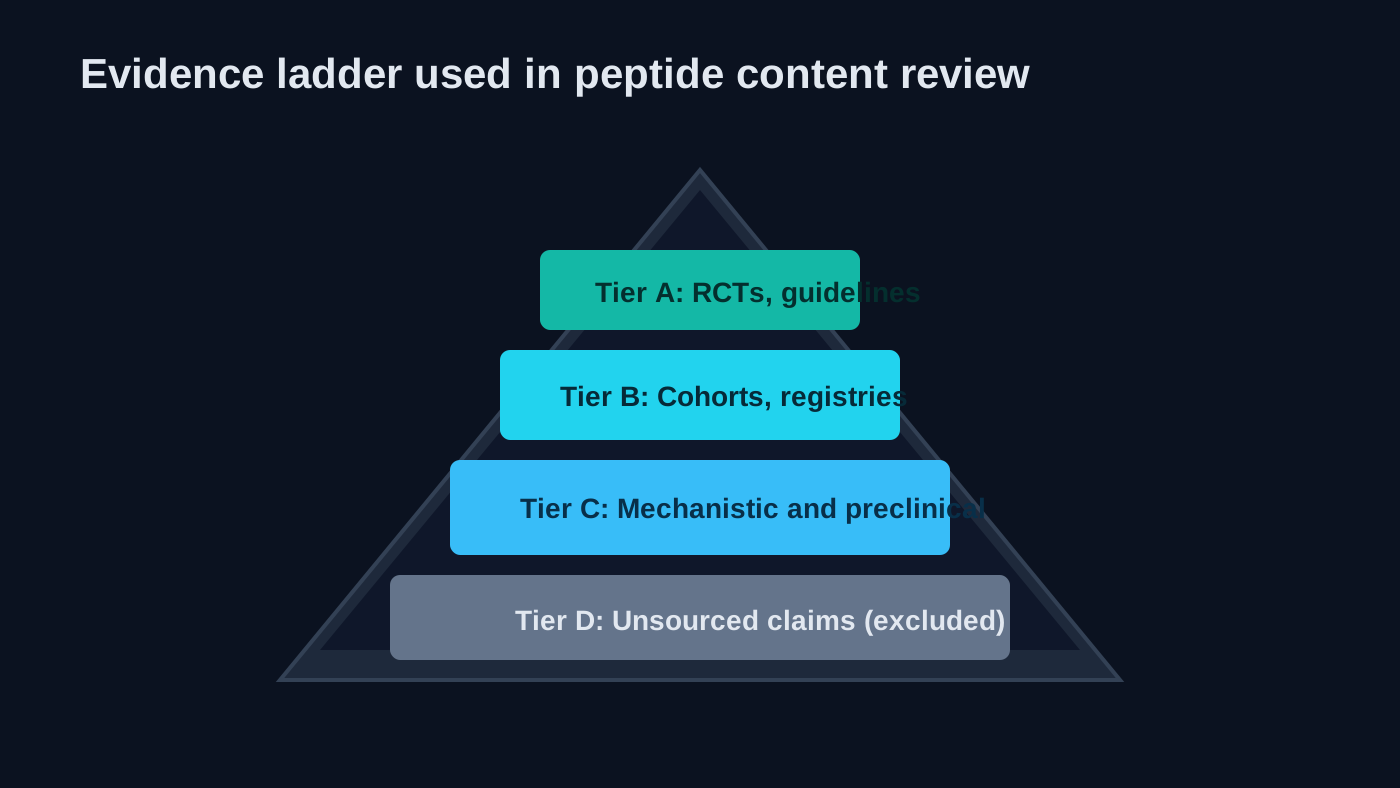
This ladder helps us keep conclusions consistent across articles.
Tier A includes higher confidence human evidence and guideline level sources.
Tier B includes observational work and practical registries with useful but limited certainty.
Tier C includes mechanistic and preclinical context that can guide questions.
Tier D includes unsourced or low accountability claims that should not drive high impact decisions.
How to evaluate writing quality on peptide websites
Style quality matters because language can hide uncertainty. Strong writing is clear, specific, and measured. Weak writing often relies on urgency, broad promises, and repeated certainty without support.
Look for articles that define scope, provide references, and separate hypothesis from evidence. Good pages usually include transparent citations and plain language summaries.
If a page uses high certainty language with minimal sourcing, confidence should stay low even if the design looks polished.
Building a practical learning path
A useful learning path moves from fundamentals to interpretation and then to tools.
Start with this guide and learn how evidence quality works.
Move next to pre-flight risk management in What to check before starting any peptide plan.
Then review calculation hygiene in How to use the reconstitution calculator correctly.
This sequence keeps context ahead of implementation details.
Common beginner mistakes
The first mistake is treating all peptides as equal in evidence quality.
The second mistake is confusing mechanism logic with demonstrated outcomes.
The third mistake is skipping baseline context and trying to interpret change without stable reference points.
The fourth mistake is using one source only. Cross source comparison improves quality.
The fifth mistake is reading for confirmation instead of reading for uncertainty.
How to compare two articles on the same peptide
When two sources disagree, compare their evidence map before comparing their conclusions. Start by listing every citation from each article and tagging each citation by evidence tier. Then mark whether each citation is primary data, secondary interpretation, or unsourced opinion.
Next compare endpoint quality. If one article focuses on mechanism summaries while the other includes human outcome data with clear endpoints, confidence should usually favor the second article. Also compare the publication date. Older evidence can still be useful, but new safety signals may shift interpretation.
Then review language discipline. An article that uses absolute claims with limited citations is usually less reliable than an article that uses precise confidence language and transparent uncertainty statements.
This side by side method is simple, but it prevents most false ties where weak and strong sources appear equally credible at first glance.
Quick reading checklist for each new article
- Identify the claim type and confidence level
- Verify whether references are primary and relevant
- Check endpoint relevance and follow up duration
- Look for explicit uncertainty language
- Confirm that risk and escalation context are present
This checklist keeps reading grounded and helps you avoid low signal conclusions.
Final perspective
Peptide education is most useful when it improves decision quality, not when it amplifies confidence without support. A strong foundation does not remove uncertainty. It helps you handle uncertainty with discipline.
If you keep evidence hierarchy, safety framing, and language precision at the center of your reading process, your interpretation quality will improve quickly. That improvement is the real advantage over time.